
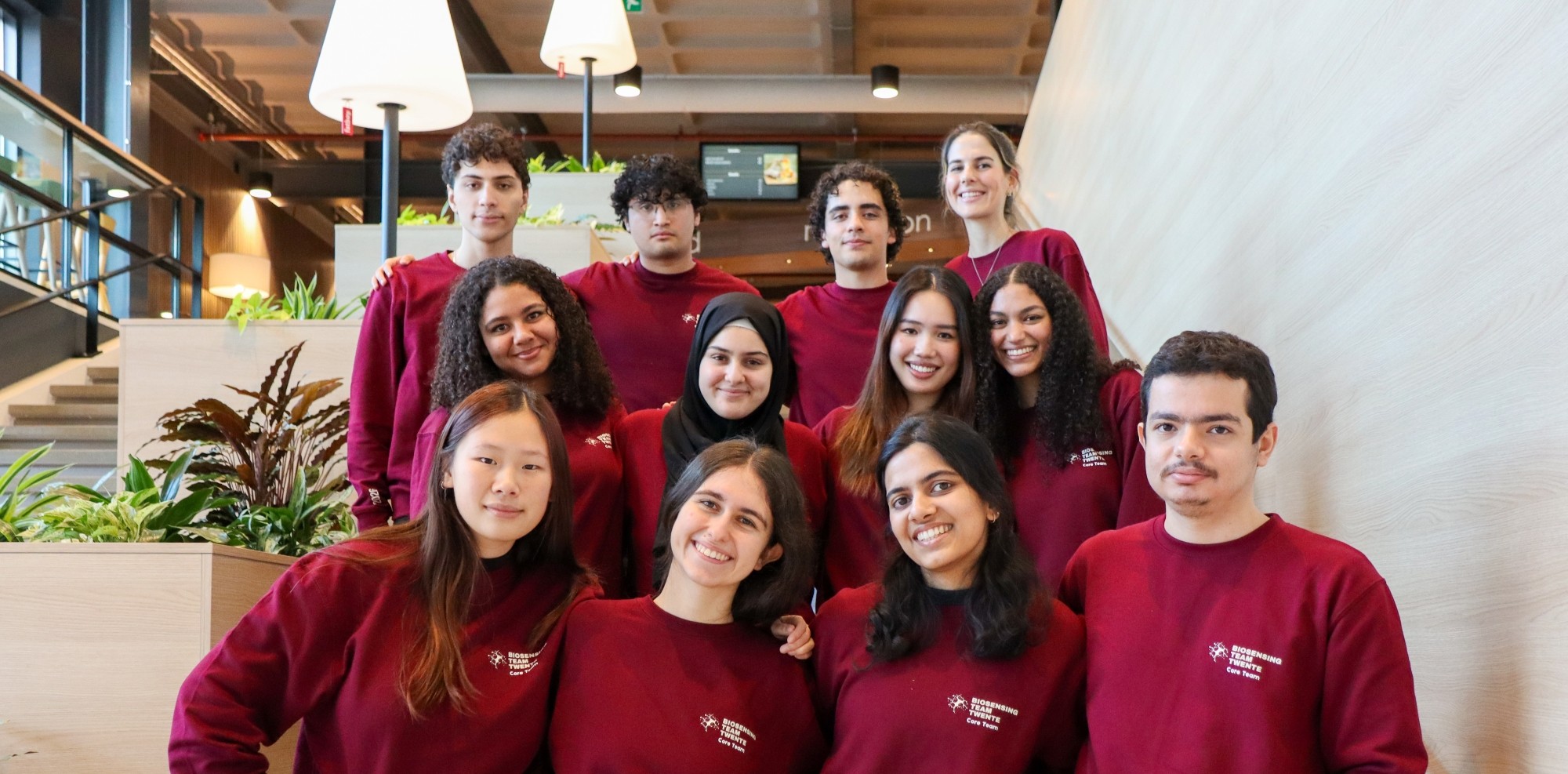
Biosensing Team Twente 2025/2026
We are a team of 13 individuals from different backgrounds and studies.
Amirhossein Zaboli
Team Captain
Jada Heemskerk
Team Captain
Ane Gutiérrez Martínez
Device Design & Business
Danai Spyridakou
Chemistry
Rodrigo González
Device & Electronics
Jasmine Ahmed
Chemistry
Ilaria Vonella
Device Design & Public Relations
Isaac Aguirre Diaz
Electronics & Chemistry
Mohamed Daher
Electronics & Business
Júlia Ribot
Device Design & Business
Nour Hasnaoui
Chemistry, Business & Marketing
Francisco Lopes
Electronics & Device Design
Yilin Chen
Business & Marketing and Communications
Coaches, Board, and Supervisors
Vinaya Tennakoon
Chair
Matteo Pozzato
Technical Manager
Fernando Rodriguez
Internal Relations Manager
Paulo Palomo
Treasurer
Andrea D’Silva
External & Communication Manager
Deikshi Kumari SN
Secretary
Dr. Ir. Pep Canyelles Pericas
Coordinator, Supervisory Board
Dr. Mohammad Saghafi
Research Coordinator, Supervisory Board
Bahar Atik, PhD Candidate
Laboratory Supervisor
Jannis Schlicke
Laboratory Supervisor
Sensus Competition 2026
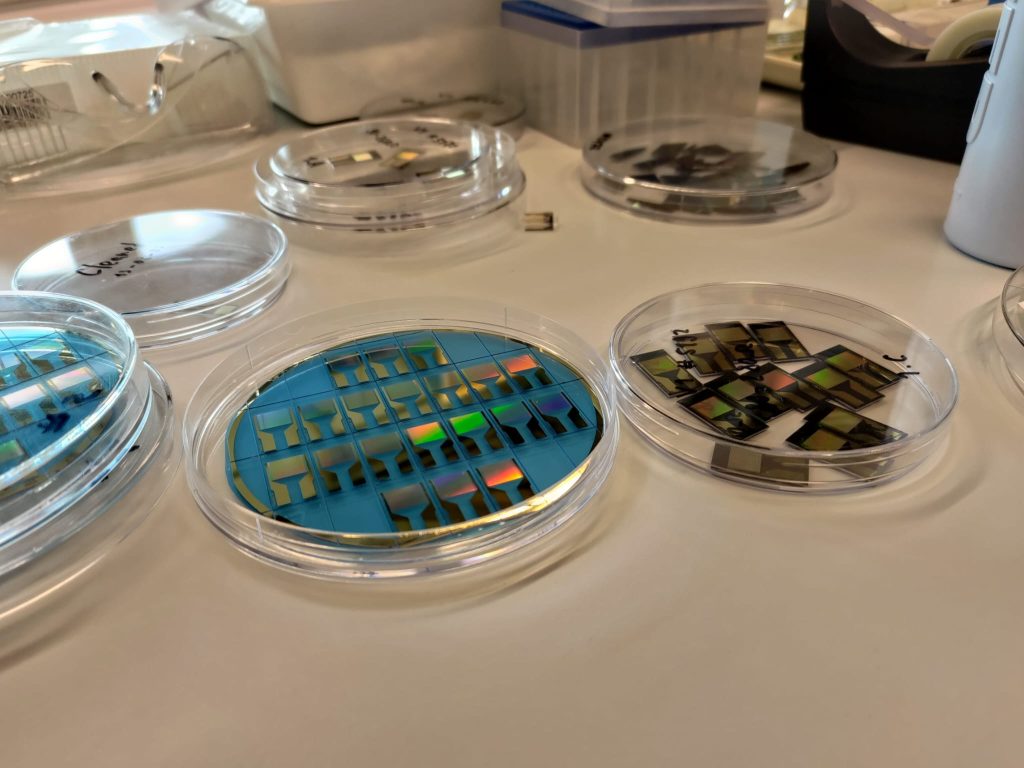
At Biosensing Team Twente, we are excited to participate in the SensUs Competition 2026, an international challenge where students from around the world work on innovative biosensing solutions for major healthcare challenges. This year’s edition is centered on Parkinson’s disease, with a focus on developing systems for the continuous measurement of levodopa in interstitial skin fluid.
Our goal is to create a biosensor that can monitor levodopa levels continuously and in real time, helping to make treatment more precise and responsive to the needs of each patient. By targeting interstitial skin fluid as the measurement matrix, we aim to contribute to a monitoring approach that is minimally invasive, practical, and suitable for future wearable applications.
Why Does This Matter?
Parkinson’s disease is a progressive neurological disorder in which patients often depend on levodopa to manage their symptoms. Although levodopa remains the main treatment, its effects can vary significantly throughout the day. Concentrations that are too low may lead to the return of motor symptoms, while concentrations that are too high can
cause unwanted side effects such as dyskinesias. Continuous monitoring could offer a way to better understand these fluctuations and support more personalized dosing strategies.
Our Approach
- Advanced Biosensing Technology – Utilizing state-of-the-art detection methods to ensure precise and reliable measurements.
- Future-oriented usability – Developing with wearability, accessibility, and real-world implementation in mind.
- Continuous monitoring concept – Continuous monitoring concept
Through SensUs 2026, we want to contribute to the future of Parkinson’s care by developing technology that brings monitoring closer to the patient. By combining innovation, usability, and clinical relevance, we hope to help enable treatment that is smarter, more personalized, and better suited to everyday life.